Process
How Venora Match works
Four stages, from the applications landing in your inbox to a decision you can account for months later. Venora Match does the reading and writes down its reasoning; a person makes every call.
Bring in the role and the CVs
Import the job description and the applications you received, in PDF or Word. Venora Match extracts and structures what is inside them, including the badly formatted ones.
Applications arrive through a public application page, an entry API, email-to-API, or a connector — whichever route suits how candidates already reach you. Candidate consent is captured at intake, and no payload is stored without it.
CVs come in as PDF or Word. The parser is built for the real thing: two-column layouts, tables, a scanned page in the middle, a career history written back to front. What it extracts is structured — roles, dates, skills, education — rather than left as a wall of text.
The vacancy is described the way you would describe it to a colleague: the requirements that are essential, the ones that are preferred, and the experience and education the role actually needs.
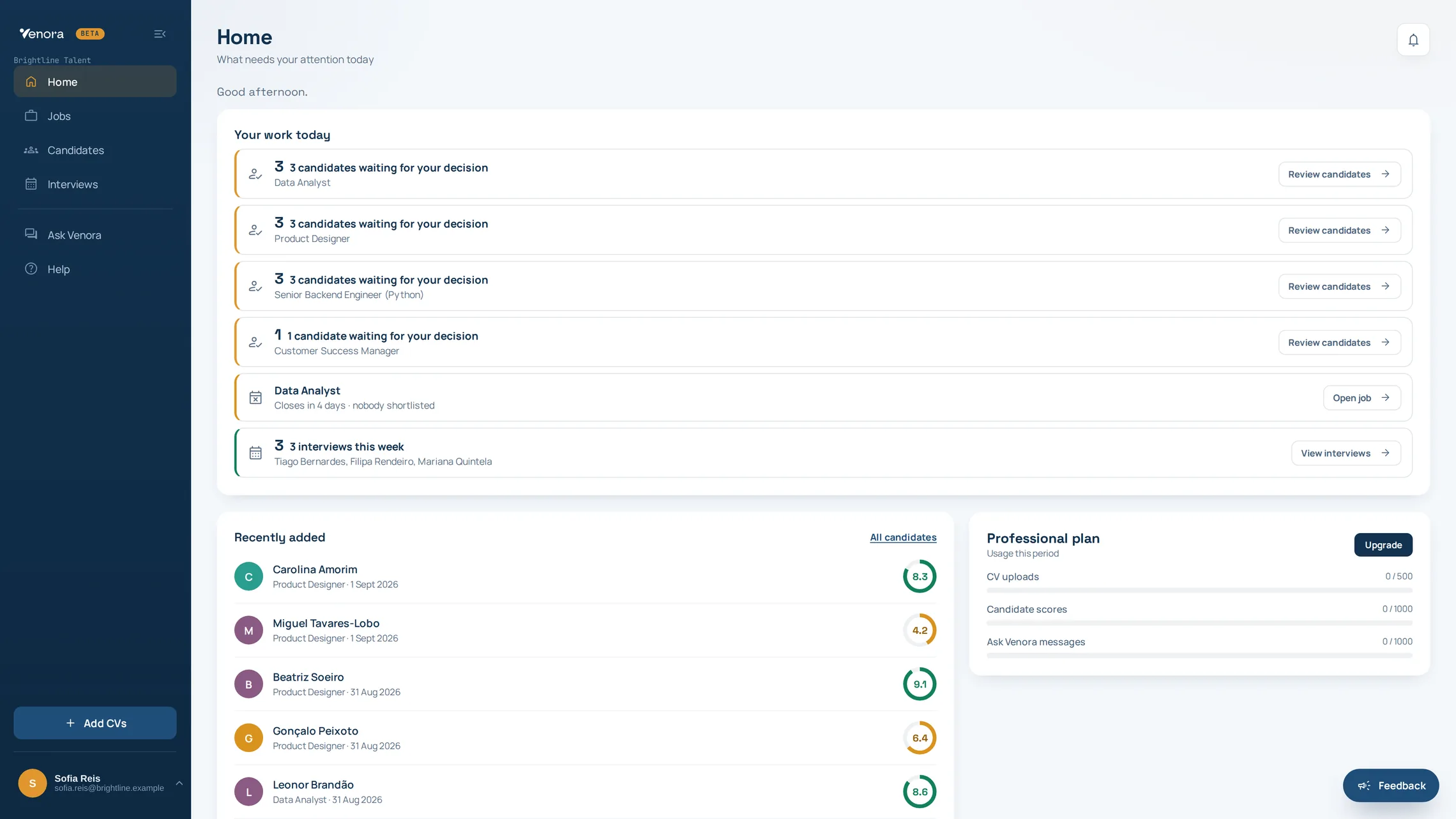
Venora Match scores the fit
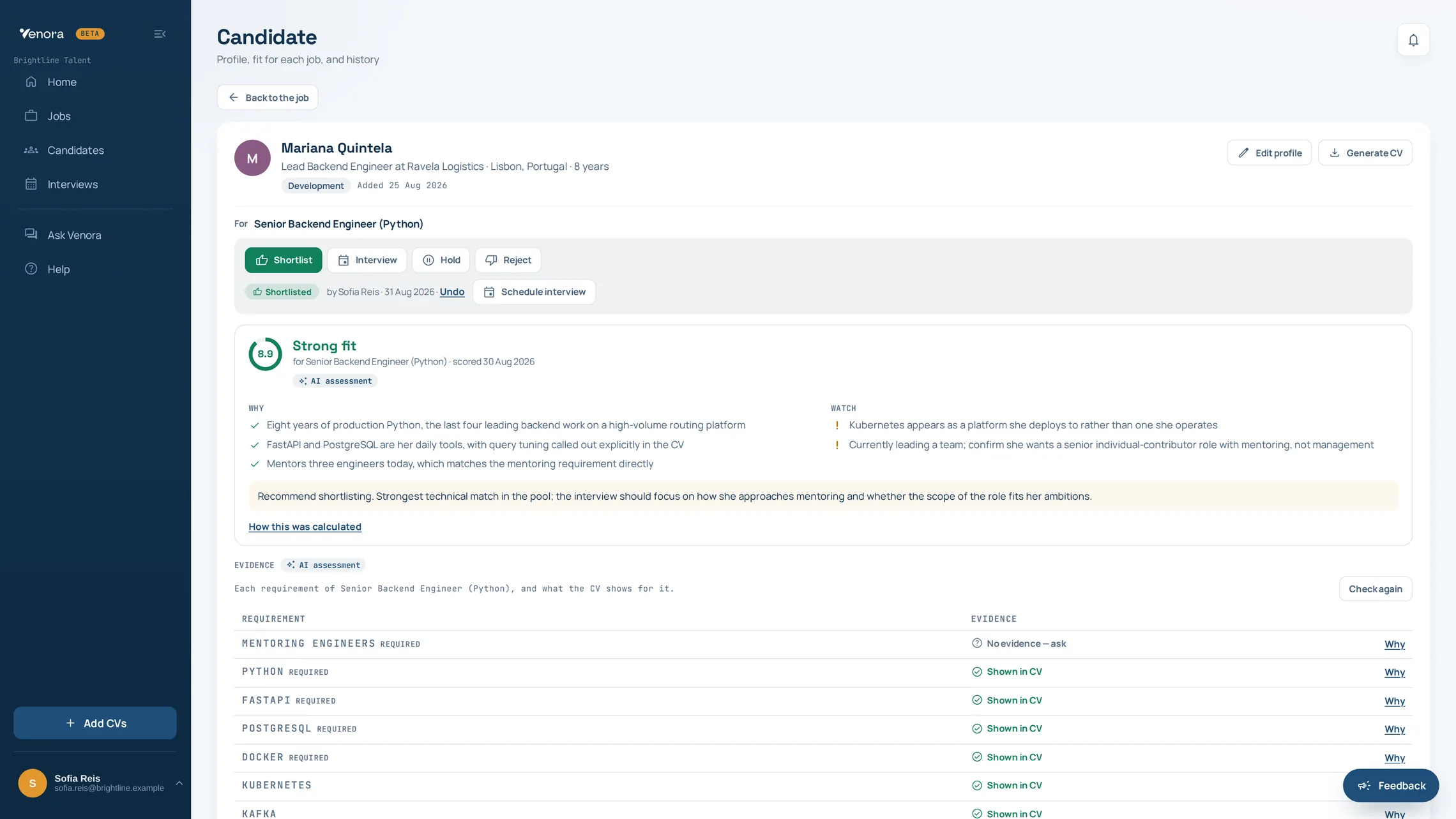
Each candidate is measured against the requirements you set — skills, experience, education and preferred criteria — with a fit score and the reasoning written out.
Matching is done against the requirements of that vacancy, not against a keyword list. A candidate who describes the same work in different words is not discarded for using the wrong noun.
Identifying details are removed before the analysis runs, so candidates are compared on what they have done rather than on who the CV says they are.
Every score arrives with its reasoning: the requirements met, the ones missing, and the evidence in the application behind each. There is a requirement-by-requirement table and a link to how the score was calculated.
The models that read the CVs are open-weight — gpt-oss-20b and gpt-oss-120b — run by OVHcloud on its own AI Endpoints in France. No AI vendor sits in the data path, and nothing you put in is used to train them.
You review and decide
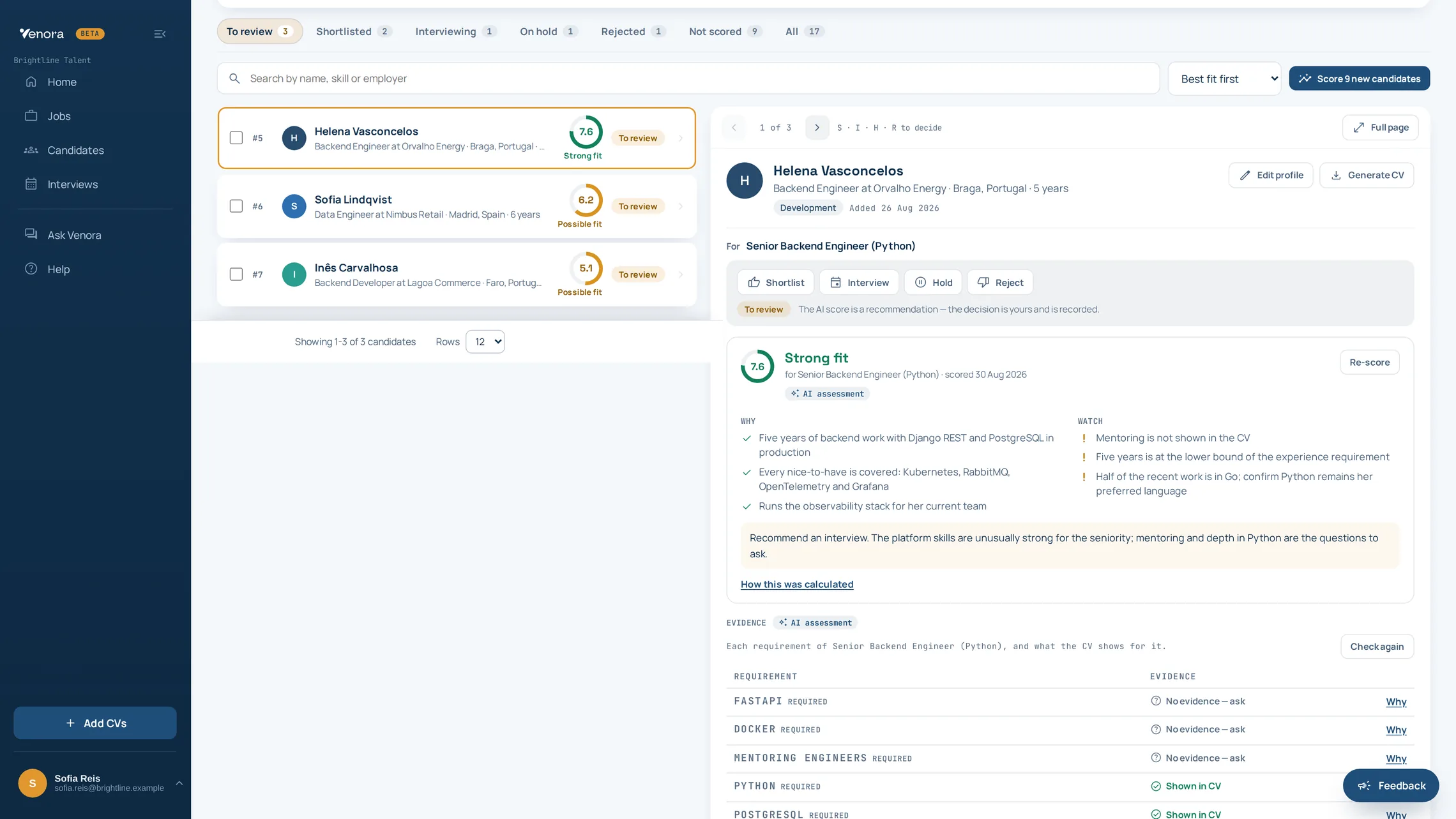
Confirm, correct or reject. Venora Match never rejects a candidate on its own. Your decision and the basis for it are recorded with the vacancy.
The review queue groups candidates by the decision they are waiting on, with the fit report open beside them. Every screen that shows a score also says that the score is a recommendation and the decision is the recruiter’s.
Nothing is decided until a person confirms it. Venora Match cannot be configured to reject candidates automatically — that is a property of the product, not a setting.
Each confirmation is written to the record with who made it, when, and on what basis. Months later, when a candidate, a client or an auditor asks why, the answer is on file rather than in somebody’s memory.
Interview with the questions it drafted
Role-specific questions for each shortlisted candidate, and structured feedback from every interviewer in one place — through to the final decision.
The analysis carries into the interview: questions drafted for that candidate and that role, drawn from the gaps and strengths the screening actually found.
Feedback from every interviewer is captured against the same criteria, in one place, so a panel of three produces one comparable record instead of three sets of notes.
The shortlisted candidate’s CV can be reformatted into your own template as DOCX or PDF — the version an agency sends to a client, without the retyping.
Why it works this way
Recruitment is a high-risk use case under the EU Artificial Intelligence Act, and the obligations that follow — human oversight, traceability, record-keeping — sit with the organisation doing the hiring. That is why the review step is not optional and why every score arrives with its reasoning: the product is shaped by what you will be asked to demonstrate, not by what is quickest to build.
The same logic decides where it runs. The platform, the models that read the CVs and the audit log are all on OVHcloud in France — the detail is on the trust centre, along with what we have not published yet.
Next: everything Venora Match does, or how agencies and in-house teams run it.
See it on one of your own vacancies
Twenty-five minutes. Bring a real role and the applications you have for it — you leave with the ranked shortlist and the reasoning behind it, whether or not you take it further.