Features
Everything Venora Match does
Grouped by the part of hiring each one belongs to. Nothing here is on a roadmap: it is what the product does today.
Matching and scoring
The part that replaces the afternoon: every application read against the role, ranked, and explained.
- Fit score per candidate and vacancy
- Each candidate is scored against the requirements of the specific role, not against a generic profile, and the pool is ordered best match first.
- Essential and preferred requirements kept apart
- A missing must-have and a missing nice-to-have are not the same thing, and the ranking treats them differently.
- Written rationale behind every score
- The reasons for and against, requirement by requirement, with the evidence from the application behind each one — and a link to how the score was calculated.
- Bias-aware screening
- Identifying details are removed before the analysis runs, so the comparison is on merit.
- PDF and Word CV import
- Including documents with irregular layouts. The information is extracted and structured automatically.
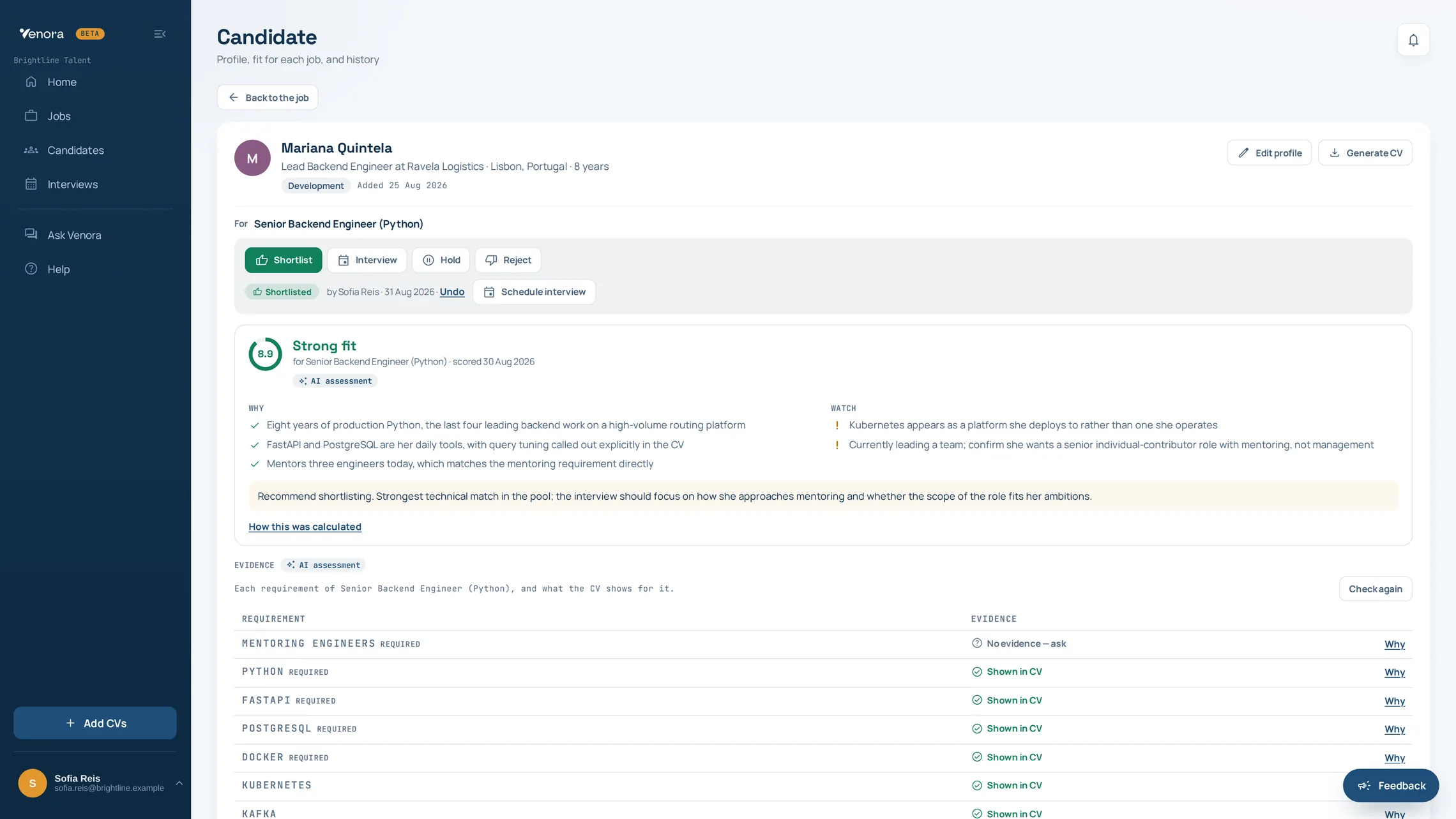
The candidate file
What you get for each shortlisted person — more than a number, and ready to act on.
- Summary, strengths and areas to develop
- A readable profile of the candidate against this role, not a transcription of their CV.
- Role-specific interview questions, drafted
- Questions written for this candidate and this vacancy, drawn from what the screening found.
- Structured interview feedback
- Every interviewer records against the same criteria, in one place, through to the final decision.
- CV reformatted to your template
- DOCX or PDF in your own layout — the version an agency sends to its client.
Your candidate pool
The people you have already spoken to, findable months later.
- Semantic search in plain language
- “Who has cloud experience and can start in March?” asked as a sentence, not as a filter stack.
- Answers in the language you ask in
- Ask in English or Portuguese; the search reads CVs in the language they were written in.
- The reasoning shown with each answer
- A result you can check, rather than a list you have to trust.
Oversight and the record
Recruitment is a high-risk use case under the EU AI Act. These are the parts that exist because of it.
- A human confirms every decision
- Venora Match ranks and explains. It does not reject anyone on its own, and it cannot be configured to.
- A decision record per candidate
- The score, the rationale, who confirmed it and when — stored with the vacancy.
- Candidate consent captured at intake
- No application payload is stored without it.
- Audit log in your workspace
- Kept with the rest of your data on OVHcloud in France.
Workspace and platform
The surrounding machinery: who can get in, what it connects to, and where it runs.
- Recruiter workspace
- Create and publish vacancies, run a lightweight pipeline, and see every score with its justification.
- Multiple intake channels
- A public application page, an entry API, email-to-API and connectors.
- Automation API
- Rate-limited on Professional, unrestricted on Business — for teams that want Venora Match inside their own workflow.
- Enterprise SSO and custom branding
- SAML single sign-on, a private or dedicated model option and your own logo and colours, on the Business plan.
- Hosted on OVHcloud in France
- Platform, models and audit log in the same European infrastructure. Nothing is used to train the models.
For the order these fit together in, read how Venora Match works. For what each plan includes, see pricing. For where the data lives and which models read it, the trust centre answers in full.
Bring a role and see the features on real applications
Twenty-five minutes. Bring a real role and the applications you have for it — you leave with the ranked shortlist and the reasoning behind it, whether or not you take it further.