Venora Match vs Textkernel
A Textkernel alternative for teams that need the reasoning, not just the fields
Both read CVs. The difference is what you get back, and who has to build the rest of it.
What Textkernel is good at
Textkernel has spent a long time on CV parsing and does it at a scale and in a range of languages that few can match. If what you need is structured data flowing into a system you are building yourself, it is a serious piece of infrastructure and this page is not going to tell you otherwise.
What are you actually buying?
| Criterion | Venora Match | Textkernel |
|---|---|---|
| What you receive | A working recruiter workspace: ranked candidates, fit reports, review queue | An API returning structured data and match results |
| Who uses it day to day | Recruiters and hiring managers | Developers, via the system they build around it |
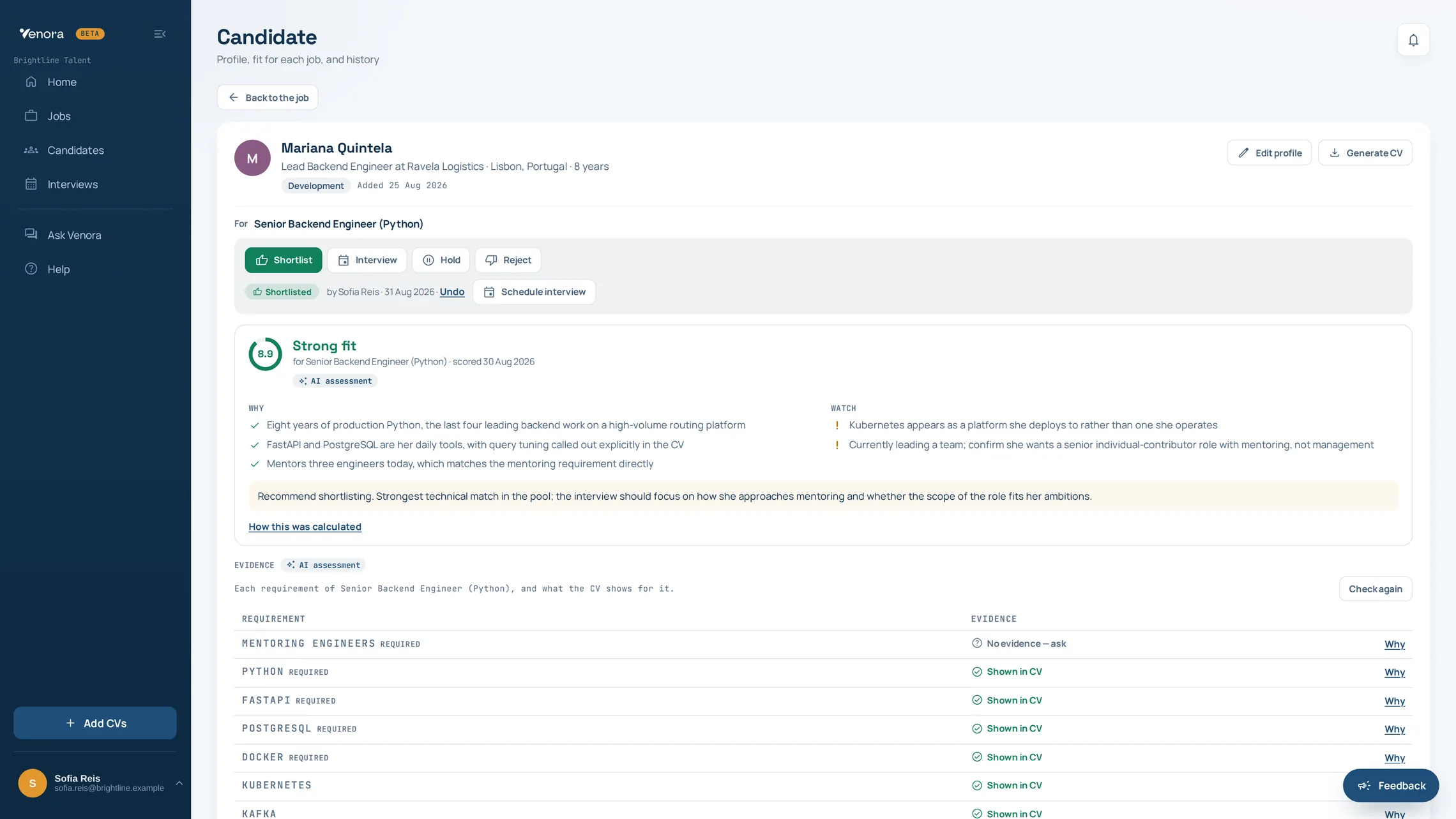
| Explanation of a match | Written rationale, requirement-by-requirement evidence, link to how the score was calculated | Scores and extracted fields to interpret yourself |
| Human oversight | A person confirms every decision; it cannot be configured otherwise | Whatever the system you build enforces |
| Where the analysis runs | OVHcloud in France, on open-weight models | Vendor infrastructure; check the current DPA |
| Starting point | Free workspace, self-service, published prices from €99/month | Commercial engagement and an integration project |
The Textkernel column describes what that product is built and sold to do. Capabilities change; check the current documentation before you decide.
Parsing is a component. A hiring decision is a process.
A parser turns a CV into fields. Everything between those fields and a defensible shortlist — ranking against this vacancy, the reasoning behind each ranking, the review step, the record of who decided what — is work somebody still has to do. With a parsing API, that somebody is your engineering team. Venora Match ships that part as the product.
The reasoning is the deliverable
A score with no explanation asks a hiring manager to trust a number for a decision they will have to justify. Venora Match writes out the reasons for and against, shows the evidence in the application behind each requirement, and links to how the score was calculated. That is what a candidate, a client or an auditor is actually asking for when they ask why.
Where the CVs go
Candidate data is personal data, and buyers increasingly ask exactly where it goes. Venora Match runs on OVHcloud in France, and the models that read the CVs — gpt-oss-20b and gpt-oss-120b — are open-weight models OVHcloud runs on the same European infrastructure. There is no AI vendor in the data path, and nothing you upload trains anything.
If you have engineers and want a component, Textkernel is a good component. If you have recruiters and want the shortlist to hold up, book a demo and we will run Venora Match on a real vacancy of yours.
More detail: what Venora Match does, how it works, where your data lives, or the other comparisons.
See it on one of your own vacancies
Twenty-five minutes. Bring a real role and the applications you have for it — you leave with the ranked shortlist and the reasoning behind it, whether or not you take it further.