Venora Match vs native ATS AI
Keep your ATS. Add screening that shows its reasoning.
An applicant tracking system is built to move candidates through stages. Deciding which candidates deserve a stage is a different job.
What your ATS is good at
Pipelines, stages, scheduling, compliance workflows, offer management and the reporting your operations team lives in. None of that is what this page is arguing with — you should keep it.
A feature, or the thing itself?
| Criterion | Venora Match | Built-in ATS AI |
|---|---|---|
| What it is | A specialist matching product | A feature alongside the pipeline |
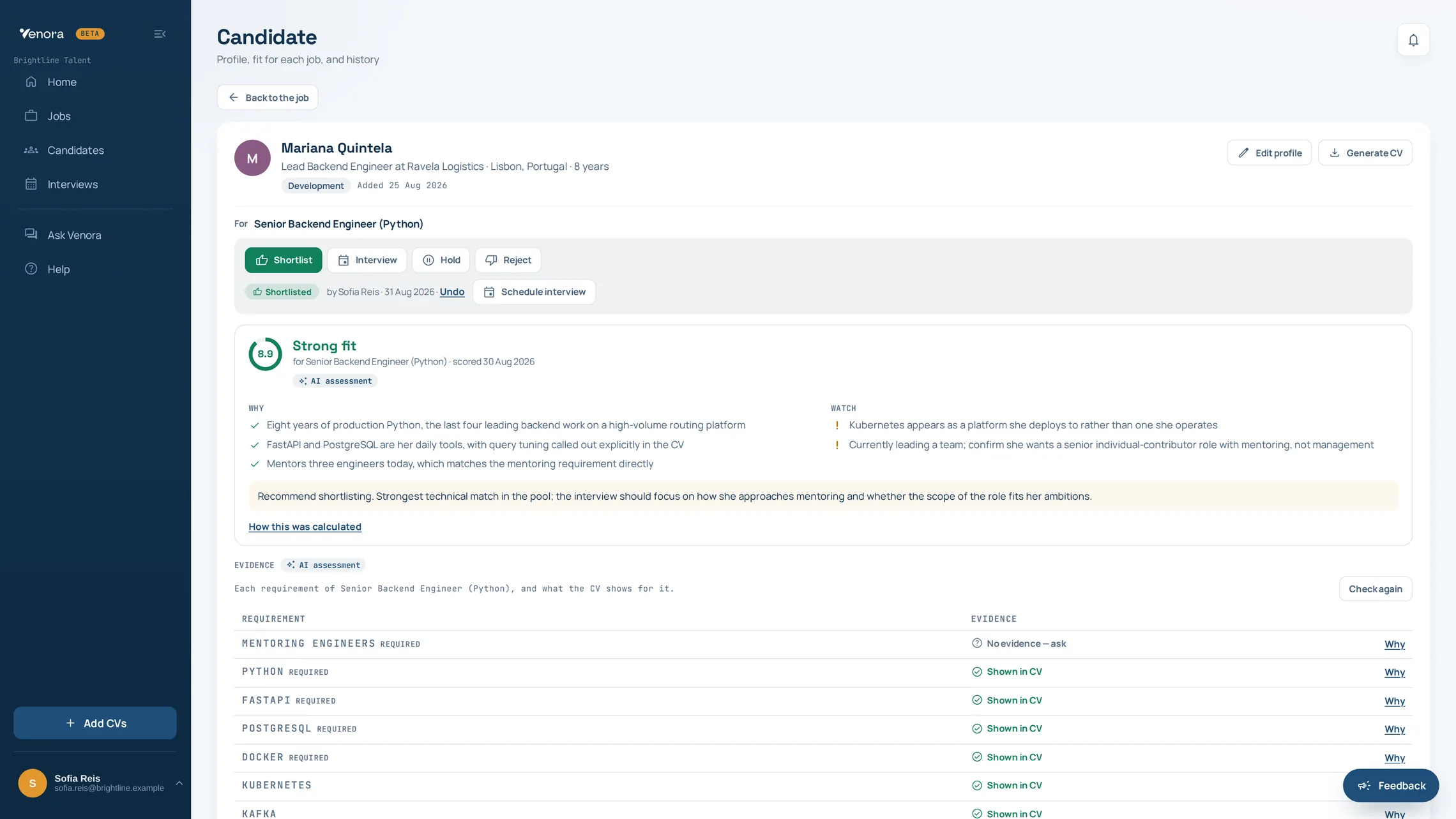
| What you get per candidate | Score, reasons for and against, evidence per requirement, draft interview questions | Typically a score and a short summary |
| Auditability | Decision record: who confirmed, when, on what basis | Varies; often not exposed |
| Automatic rejection | Not possible — a person confirms every decision | Often configurable |
| Where the analysis runs | OVHcloud in France, open-weight models named publicly | Usually an undisclosed third-party model |
| If you change ATS | Comes with you | Stays behind |
The Built-in ATS AI column describes what that product is built and sold to do. Capabilities change; check the current documentation before you decide.
Screening is the regulated part
Under the EU AI Act, AI used to screen applicants is a high-risk use case, and the obligations that follow — human oversight, traceability, record-keeping — land on the organisation deploying it. An AI summary added to a pipeline view is rarely built with those obligations as its starting point. Venora Match is: a person confirms every decision, and every confirmation is recorded with its basis.
You do not have to migrate anything
Applications reach Venora Match through a public application page, an entry API, email-to-API or a connector, and the automation API is there for teams that want it inside their own workflow. Your ATS keeps doing what it is good at.
The question a generic summary cannot answer
Six months from now, a rejected candidate asks why. A one-line AI summary generated at the time and never stored is not an answer. The fit report — requirements met, requirements missed, the evidence for each, and the recruiter who confirmed it — is.
Bring a vacancy and the applications you received for it. Twenty-five minutes, and you keep the shortlist whether or not you take it further.
More detail: what Venora Match does, how it works, where your data lives, or the other comparisons.
See it on one of your own vacancies
Twenty-five minutes. Bring a real role and the applications you have for it — you leave with the ranked shortlist and the reasoning behind it, whether or not you take it further.